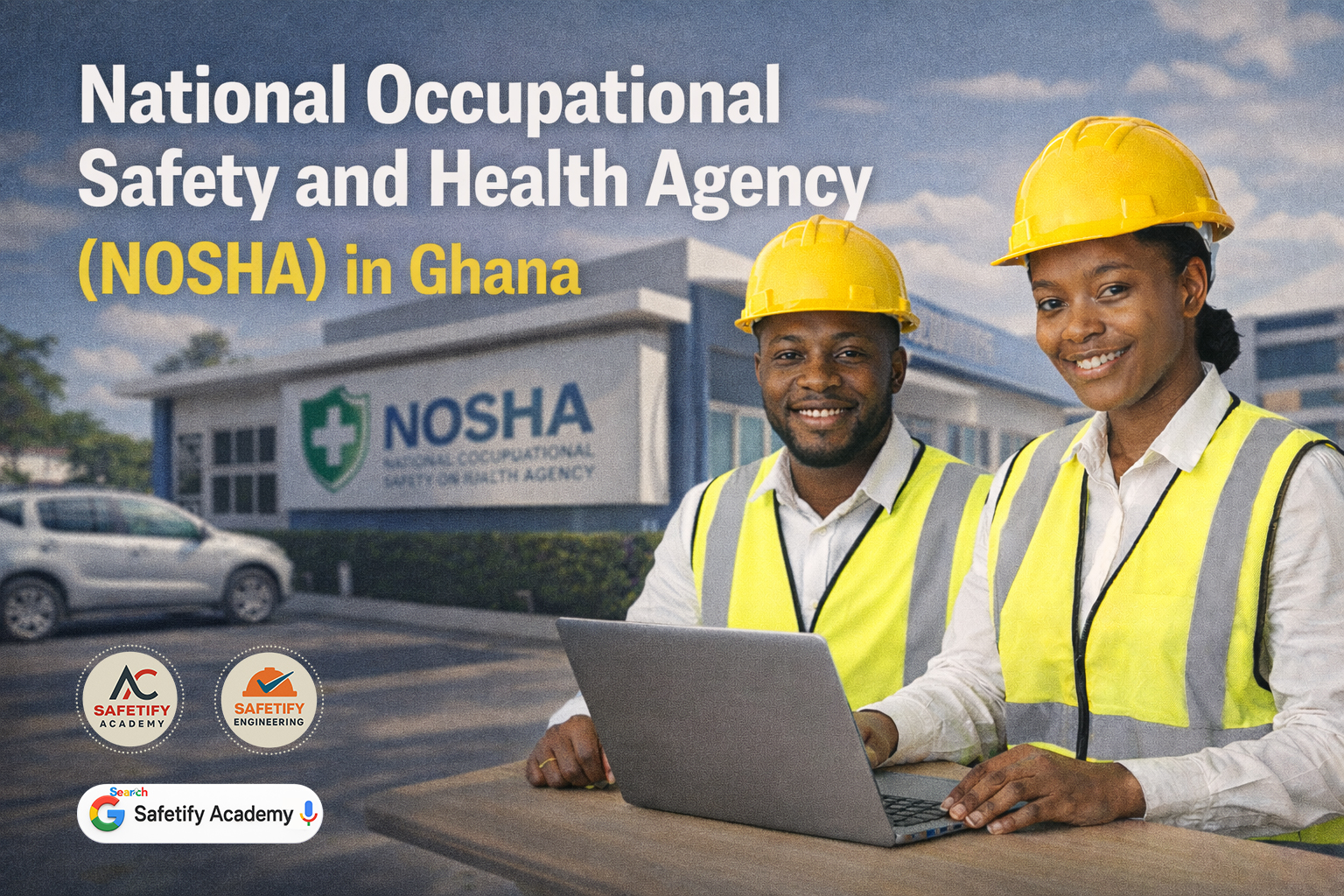
National Occupational Safety and Health Agency (NOSHA) in Ghana: Benefits and What OSH Professionals Should Prepare For
The Coming of Ghana’s National Occupational Safety and Health Agency (NOSHA): What It Means for OSH Practitioners and How to Prepare
Ghana is on the brink of a major transformation in workplace safety and health with the passage of the bill to establish a National Occupational Safety and Health Agency (NOSHA). This landmark legislation seeks to secure the safety, health, protection, and wellbeing of persons at work—including employers, workers, and even the general public—against risks and hazards arising from work activities.
Once fully operational, this Agency will change how occupational safety and health (OSH) is practiced, regulated, and enforced across the country. For Ghanaian OSH practitioners, this is both an opportunity and a call to action.
A Law That Applies to Every WorkplaceOne of the most powerful aspects of this Act is its wide application: it applies to all workplaces. This means construction sites, factories, offices, schools, hospitals, shops, farms, and even small enterprises will fall under a unified national OSH framework.
For practitioners, this expands both responsibility and opportunity—more sectors will need competent safety professionals, structured systems, and compliant procedures.
Key Objectives of the Act — And Why They MatterThe Act sets out clear objectives that redefine how work and worker wellbeing should be managed in Ghana:
1. Promoting Total Worker WellbeingThe law aims to promote the physical, mental, and social wellbeing of workers at the highest standard.
This moves OSH beyond just preventing accidents—it recognizes mental health, stress, fatigue, and psychosocial risks as real workplace issues practitioners must address.
What this means for OSH professionals:
You’ll need broader skills in health promotion, mental wellbeing, and human-centered safety management—not just hazard control.
The Act seeks to protect all persons at the workplace from risks arising from work activities. This strengthens the legal basis for hazard identification, risk assessment, and control measures.
For practitioners:
Expect higher expectations for:
-
Risk assessments
-
Safe systems of work
-
Inspections and audits
-
Incident investigations
-
Preventive controls
Competence and documentation will matter more than ever.
3. Protecting the General PublicImportantly, the law also protects the public from risks arising from work activities—think construction sites, industrial plants, transport operations, and hazardous installations.
For OSH practitioners:
Your role expands beyond workers to public safety, community risk management, and environmental interfaces. This raises the professional profile and responsibility of safety officers and consultants.
The Act emphasizes adapting work to the physiological and psychological needs of workers—a core principle of ergonomics and human factors.
This means:
-
Better workstation design
-
Safer job methods
-
Reduced fatigue and strain
-
Lower risk of injuries and occupational diseases
OSH practitioners who understand ergonomics, human factors, and work design will be in high demand.
5. Stronger Worker–Employer CooperationThe law promotes consultation and cooperation between employers and employees in achieving safety and health objectives.
In practice:
-
More safety committees
-
More worker involvement in safety decisions
-
More training and awareness programs
-
Better safety culture
OSH professionals will increasingly act as facilitators, trainers, and advisors, not just rule enforcers.
6. Structured Safety and Health ProgrammesThe Act encourages the development, implementation, monitoring, and evaluation of workplace safety and health programmes at enterprise level and through tripartite or bipartite arrangements.
For practitioners:
This means:
-
More formal OSH management systems
-
More KPIs, audits, and reviews
-
More demand for competent safety managers and consultants
-
More focus on measurable performance, not just compliance
Finally, the Act provides for a national system that continuously improves OSH standards, keeping pace with technology and changing work practices.
This is huge. It means OSH in Ghana will no longer be static. Standards, expectations, and enforcement will evolve.
For professionals, this means continuous learning is no longer optional—it’s a career survival skill.
What Ghanaian OSH Practitioners Should Start Preparing for NowBefore NOSHA is fully established and operational, smart practitioners should start positioning themselves:
1. Upgrade Your Knowledge and Qualifications-
Strengthen your understanding of OSH management systems
-
Learn more about ergonomics, mental health, and human factors
-
Stay updated with international standards (ISO 45001, ILO conventions, best practices)
-
Risk assessments
-
Policies and procedures
-
Training records
-
Incident reporting and investigations
-
Audits and inspections
Regulation will likely mean “If it’s not documented, it didn’t happen.”
3. Build Competence in Training and CommunicationWith stronger consultation and cooperation requirements, OSH practitioners must be able to:
-
Train workers effectively
-
Communicate risks clearly
-
Engage management and employees
-
Build safety culture, not just enforce rules
Once NOSHA is active, expect:
-
Inspections
-
Compliance checks
-
Higher expectations from employers
-
Greater legal and professional responsibility
Being proactive now will protect both your career and your credibility.
The Role of Safetify AcademyThis is exactly where institutions like Safetify Academy become critical—helping practitioners:
-
Upgrade skills
-
Understand new legal expectations
-
Build modern, practical OSH competence
-
Transition from basic safety practice to professional, system-based OSH management
The establishment of Ghana’s National Occupational Safety and Health Agency (NOSHA) marks a new era for workplace safety, health, and wellbeing. For OSH practitioners, this is not a threat—it is a massive opportunity to grow professionally, increase relevance, and raise standards across all sectors of the economy.
Those who prepare early—by upgrading skills, systems, and mindset—will not only stay relevant but will become leaders in Ghana’s new OSH landscape.
Tags :